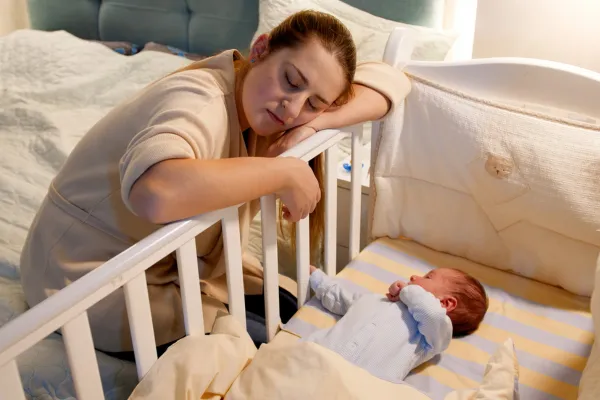
You Are Not Behind: Navigating Newborn Sleep When Everyone Has a Different Opinion
You brought your baby home, and suddenly everyone has advice.
Your mother-in-law swears you just need to let the baby cry it out. Your own mom insists she always rocked you to sleep and you turned out fine. Your partner read three different books and each one said something different. The internet served you seventeen contradictory articles before breakfast.
And somewhere in the middle of all of it, you are just trying to get a few more hours of sleep and make sure your baby is okay.
This is one of the most common experiences new parents describe: not just the exhaustion, but the noise. The competing voices, the unsolicited opinions, and the creeping worry that somehow you are already doing it wrong.
You are not doing it wrong. And you are not behind.
This post is here to help you understand why newborn sleep advice feels so conflicted, how to evaluate what actually applies to your baby and your family, and how to bring the people around you into a shared approach that makes caregiving feel more consistent and less chaotic.
Why Newborn Sleep Advice Feels So Contradictory
Newborn sleep is one of the most researched and most debated topics in early parenting, and that combination creates a lot of noise.
Part of the challenge is that infant sleep science has evolved significantly over the past few decades. What grandparents were told is often different from current guidance. What was standard practice in one generation may now be understood differently in light of new research on safe sleep, infant brain development, and caregiver wellbeing.
At the same time, there is a wide range of approaches that fall within safe and supportive practice. Families have different values, different living situations, different babies, and different needs. What worked beautifully for one family may not translate to another, not because one approach is right and the other is wrong, but because context matters.
When you layer in the internet, where every approach has its own passionate community and its own set of testimonials, it becomes even harder to know where to anchor.
The good news is that you do not need to resolve every debate. You just need to build an approach that is safe, sustainable, and consistent for your specific baby and family.
What Current Research Actually Tells Us About Newborn Sleep
Before sorting through opinions, it helps to understand what newborn sleep actually looks like developmentally.
Newborns sleep in short cycles, typically ranging from 45 minutes to a few hours. Their circadian rhythms are not yet developed at birth, which means day and night are not yet distinct to them. This is not a sleep problem. It is developmentally normal biology.
Most newborns need anywhere from 14 to 17 hours of sleep in a 24-hour period, but that sleep is distributed across many shorter windows rather than one long stretch. Expecting a newborn to sleep through the night in the early weeks does not align with where they are developmentally.
The American Academy of Pediatrics provides clear, evidence-based safe sleep guidelines, including placing babies on their back on a firm, flat surface, keeping the sleep space free of soft bedding and loose items, and room-sharing without bed-sharing for at least the first six months. These guidelines are a strong and reliable foundation regardless of which other approach a family chooses to follow.
Beyond safe sleep fundamentals, a lot of what gets debated, including whether to use a pacifier, how to respond to night wakings, and when to introduce more structure, involves personal values and infant temperament as much as it involves hard science. There is not always one correct answer, and that is actually okay.
How to Evaluate the Advice You Are Receiving
Not all advice carries the same weight, but that does not mean everything outside of official guidelines is useless. Here is a simple way to think about it.
Start with safe sleep non-negotiables. The AAP guidelines on safe sleep exist to reduce risk, and they apply to every family. [Link to AAP safe sleep page] These are not a matter of personal preference. Everything else builds from there.
Next, consider the source. Advice from a pediatric sleep consultant, your child's pediatrician, or a certified postpartum professional carries different weight than a comment in a Facebook group. That does not mean personal experience has no value, but it helps to know who is speaking from training and who is speaking from their own single experience.
Then consider your baby. Infant temperament varies significantly. Some babies are naturally easier to settle. Others are more sensitive to transitions or stimulation. An approach that worked for your neighbor's baby may not match your baby's wiring, and that is not a reflection of your parenting.
Finally, consider sustainability. The best approach is one that your family can actually maintain. If a strategy requires something that leaves you or your partner completely depleted, it is worth exploring whether there is an alternative that supports everyone in the household.
Navigating Differences With Your Caregiving Circle
One of the most common sources of stress for new parents is not just having different opinions in the house but feeling like those differences create inconsistency for the baby.
Consistency in newborn sleep is genuinely helpful. Babies orient to patterns, and when caregivers respond differently from one another, it can make settling harder over time. This is not about creating a rigid schedule, but about having a shared language and a shared approach.
When grandparents, partners, or other caregivers hold different assumptions about sleep, the most effective approach is usually a calm, direct conversation that focuses on what works for the baby rather than what is right or wrong.
A few things that help:
Acknowledge that their experience and intentions matter. Most people offering advice are doing so because they care. Starting from that place keeps conversations from becoming defensive.
Share information rather than corrections. Instead of saying "that is not how we do it," try "here is what we have been working on and why it seems to help."
Be specific about the things that matter most. You do not need alignment on every detail. Focus on the sleep practices that most affect your baby's safety and consistency, and give some flexibility on smaller preferences.
Create a brief written routine or handoff plan. When caregivers have something to reference, it takes the guesswork out of the interaction and reduces the chance of conflicting approaches happening by default. A simple one-page overview of your baby's sleep signals, settling strategies, and safe sleep setup can make a significant difference.
If there are ongoing conflicts about approach, particularly around safe sleep practices, it is okay to hold firm. You are the parent, and your baby's safety is not a negotiable point.
When to Bring in Professional Newborn Sleep Support
Sometimes the challenge is not just navigating opinions. Sometimes you are genuinely unsure what approach to take, or you have been trying multiple strategies and nothing seems to be working, or the sleep deprivation has reached a point where it is affecting your health and your ability to function.
This is exactly when working with a newborn sleep consultant can help.
A sleep consultant does not replace your instincts or override your values. A good consultant listens to what your family needs, what your baby is doing, and what your specific situation looks like, and then helps you build an approach that is grounded in both evidence and individual fit. They can also help you communicate that approach to the other adults in your caregiving circle so everyone is working from the same foundation.
Newborn Sleep Company offers virtual newborn sleep consulting for families navigating exactly this kind of uncertainty. Whether you need help building a consistent routine, working through a specific sleep challenge, or simply want someone in your corner who can sort through the noise with you, support is available.
You Are Allowed to Hold Your Newborn Sleep Approach With Confidence
One of the quieter struggles of new parenthood is the experience of second-guessing yourself every time a new voice enters the room.
You are allowed to gather information, make thoughtful decisions, and then hold those decisions with confidence, even when someone else would do it differently.
That does not mean closing yourself off to learning. It means trusting that you know your baby, that you are paying attention, and that you are doing the work of figuring this out. That matters.
Newborn sleep is hard. It is also temporary, and it is navigable. You do not have to do it alone, and you do not have to do it perfectly. You just have to do it with enough consistency and enough support to get through the early weeks and months with your wellbeing and your baby's wellbeing intact.
You are not behind. You are right in the middle of it, and that is exactly where you are supposed to be.
Frequently Asked Questions About Newborn Sleep
Is it normal for newborns to wake every 1 to 2 hours at night?
Yes. Newborns have short sleep cycles and immature circadian rhythms, so frequent night waking is developmentally expected in the early weeks. This does not indicate a sleep problem. It indicates a newborn.
How do I get my family members to follow our newborn sleep approach?
The most effective strategy is to focus on communication rather than correction. Share what you are working on and why, be specific about the practices that matter most for safety and consistency, and consider creating a brief written handoff guide so caregivers have something concrete to reference.
When should I start working on a newborn sleep schedule?
Most newborn sleep consultants recommend focusing on safe sleep and responsive care in the first several weeks before introducing more structure. Around 8 to 12 weeks, many families begin working toward a loose, flexible routine. A sleep consultant can help you determine what timing makes sense for your specific baby.
Does it matter that my partner and I respond to night wakings differently?
Some variation between caregivers is normal and manageable. Where consistency becomes more important is in the overall approach to settling and the safe sleep environment. If differences are creating significant tension or seem to be affecting your baby's ability to settle, it may be worth getting on the same page with the help of a professional.
What is the difference between a newborn sleep consultant and a pediatric sleep coach?
A newborn sleep consultant typically focuses on the fourth trimester and the earliest weeks of life, supporting families with feeding and sleep rhythms, safe sleep setup, and caregiver wellbeing. A pediatric sleep coach often works with slightly older infants and toddlers on more structured sleep training approaches. Newborn Sleep Company offers both newborn sleep consulting and pediatric sleep coaching depending on your baby's age and your family's needs.
